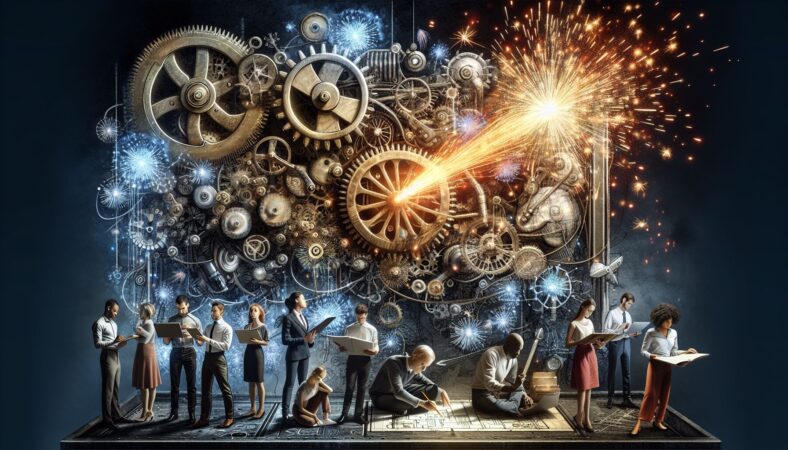
Hey tech enthusiasts! Today, I want to talk about a topic that’s sending ripples through the creative community and beyond: the rise of AI in the creative arts. As someone who’s always had a soft spot for both tech and a good piece of art, I’m buzzing with excitement to see what happens when we mix the two. If you’re like me—stuck between the passion to paint and the urge to code—you’re going to love this. So grab your latte, sit back, and let’s decode this brave new world where machines meet Michelangelo.
The Creative Code: How AI is Painting (and Playing) a New Reality
Let’s start with what’s happening right now. We’re not just talking about AI churning out repetitive pop songs or slapping together Van Gogh-style prints. Nah, we’re past that. AI is jumping headfirst into nearly every corner of the creative world—from composing symphonies that could bring tears to an android’s eye to writing novels that might make I, Robot a reality.
[In]Credible AI Musicians
Picture this: AI-driven music programs are learning from the greatest composers of all time, and they’re not just remixing Beethoven for the umpteenth time. Programs like OpenAI’s MuseNet can generate brand new compositions in all sorts of genres. I mean, who’d have thought that machines might soon challenge Beethoven for a spot on our most-played list? Personally, I’m looking forward to the best 9-part synth-bass-funk-fusion-opera powered by AI. And why not? Maybe one day, we’ll be raving about the AI origins of the Grammy-winning soundtrack of the year.
Literary AI: From Idea to Best Seller?
In other realms, we have AI messing around with storytelling. We’re seeing AI pen short stories, poetry, even screenplays. There’s this one project I’ve been following, first developed over at OpenAI, called GPT-3, that can whip out a fairly decent narrative from a single prompt. I put it to the test myself once, asking it to write a sci-fi short inspired by my morning run. The end result still had a few hiccups—repetitive phrases and whatnot—but it was eerily readable nonetheless. Who knows? In the near future, your favorite bestseller might be co-authored by a machine.
The Creative Process Rebooted: AI as the Artist’s Muse
While there’s buzz about AI replacing artists, I believe it’s less about replacement and more about collaboration. Think of AI not as the painter, but as the palette.
AI as a Collaborative Medium
Let’s consider the famous artist-refuge, Adobe, which announced a suite of AI integrations called Adobe Sensei, aimed at aiding creators in anything from automated photo edits to suggesting design elements. The difference here is that it isn’t doing the creating for the artist but rather boosting human creativity, shaking off the mundane and time-consuming tasks that can kill the creative flow.
Do you remember that feeling the first time Photoshop layers clicked or you first experienced Canva? Yeah, that game-changer moment. Artists today, using AI, are experiencing something similar. And honestly, it’s infectious. Graphic designers are getting suggestions on color schemes, musicians are tweaking AI-generated melodies, and writers are getting over their infamous blocks. The creative process itself is being reborn through this tech upgrade.
Challenges: Creativity in the Face of Code
Now, pumping the brakes here—we can’t just go all-in without stopping to reflect on some very real concerns. There are ethical questions lingering around this tech-paved artistic path.
Rights and Authorship
Alright, confession time. I tried inserting AI-generated content into my own creations. Felt a bit like cheating. I mean, who gets credit for the AI co-authored sonnet? The coder? The user? The machine? And copyright! Lordy, that’s another beast entirely. The legal world is still wrestling with these questions, and frankly, it’s like trying to unknot Christmas lights that have been in the attic since the 90s.
The Soul of Art
Another philosophical question bats around like a particularly resilient fly: Can machines truly capture the human condition? Because let’s face it, while AI can analyze thousands of works, it can’t feel the sunset the way we do. Yet, what’s emerging from this mix is something uniquely new. Perhaps AI will mirror our emotions in ways we’ve yet to understand.
Future Gazing: Is Art Unleashed?
So, where do we end up in this maze?
The Augmented Creator’s Toolkit
In my utopian crystal ball, I see AI not overpowering human creativity but supercharging it. We’ll either see AI-powered art explode into a wild new genre or settle down into a toolkit standard for every artist. Imagine a world where every creative has personalized AI assistance, fine-tuned to their personal quirks and creative flair. That’s not a soul farm; that’s freaking exciting!
New Art Forms on the Horizon
Moreover, as AI matures, it’ll likely create completely new genres of art, novel experiences that blend virtual reality with neural networks, creating things we can’t even start to imagine. And wouldn’t it be cool if instead of tuning into an evening art class, you tuned into your personalized AI design jam session? Where everyone gets to grab a digital brush and create with the machine.
Wrapping It Up
Alright folks, I’m calling it a day on this whirlwind ride. Whether you’re on the side of glee or skepticism, it’s pretty clear that AI’s role in the creative arts is one heck of a ride worth seeing through. So, while I contemplate whether my next piece of digital art needs an AI touch or just an extra espresso, I’d love to hear your musings on where you think AI is taking us. Creative partnership, dystopian art factory, or somewhere in between? Hit me up with your thoughts. Until next time—keep dreaming, keep creating, and perhaps, let a little tech into your art!