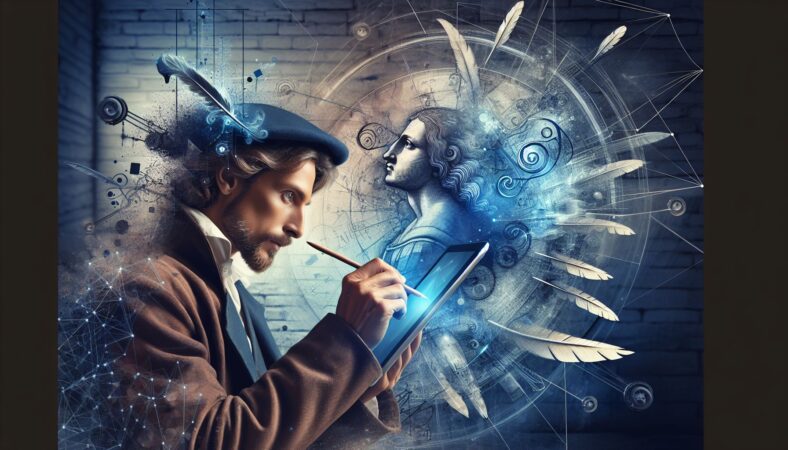
Hey there, fellow tech enthusiasts! Today, let’s dig into a mind-bending frontier that’s changing how we think about creativity: Artificial Intelligence in the creative arts. You heard me right. AI is not just limited to crunching numbers or playing chess anymore; it’s putting on the artist’s beret and dipping its virtual brush into the palette of human creativity. If you’re anything like me, you’ve been both skeptical and curious about the idea of machines generating art. Can silicon-based entities really capture the essence of creativity? Let’s find out!
The Rise of AI as Creator
From Neural Nets to Neo-Renaissance
You may have heard of OpenAI’s GPT or Google’s DeepDream. These aren’t just fancy names; they represent the cutting-edge of AI that can whip up a painting or even compose a symphony. It all started with neural networks, the algorithms powering these machines. They’ve evolved and adapted to learn the styles of Van Gogh, the storytelling techniques of Hemingway, and the musical genius of Beethoven. Are we in the midst of a new Renaissance, courtesy of AI? I’d like to think so.
The crazy thing about these technologies is their ability to learn quickly. Where it took centuries for humans to develop distinct artistic styles, AI can switch canvases in milliseconds, churning out works that range from baroque to futuristic in the blink of an eye. Imagine if Da Vinci had a supercomputer as an apprentice. Heck, Mona Lisa might’ve had a twin by now.
Breaking Down the Barriers
What gets me most excited is how AI is making art accessible to everyone. Not everyone can afford to spend years learning how to play guitar or master design principles. AI lowers the barrier to entry, giving everyone a fair shot at artistic expression. Apps like DeepArt and RunwayML are turning complex artistic processes into user-friendly interfaces while keeping the creative spark alive.
Imagine you’ve got a tune stuck in your head. Five years ago, I would’ve hummed it, maybe annoyed a friend with my off-key rendition. Now? You can hum it into an AI composer, which could return a fully orchestrated track, complete with a killer solo. Whether you’re a complete beginner or Picasso reincarnated, there’s no limit to what you can create when you’ve got AI on your team.
The Challenges of Machine-Made Art
Creativity vs. Originality
Now, let’s tackle the elephant in the room: authenticity. Can AI truly create, or is it just copying human creativity? The debate is as heated as any courtroom drama. Some say that AI is just remixing old patterns, while others argue that it’s opening up new possibilities we’ve never imagined.
Consider this: if you give AI some data from Pollock, it might splash a chaotic web of colors on canvas. But could it add the emotional depth Pollock did, inspired by his struggles and triumphs? Critics argue that while AI can generate, it can’t innovate. I think of AI more as a collaborator, a muse, rather than a rival.
Ethical and Legal Storms
Where there is art, controversy isn’t far behind. The ethics and legality of AI-generated works get messy fast: Who owns the pieces? The coder? The user? The AI itself? Sound like sci-fi? Welcome to the present, where copyright offices and legal teams are scrambling to create frameworks for a machine-made future.
We’ve heard stories about AI making headlines with artworks that sell for jaw-dropping prices at auctions, leaving artists wondering whether to celebrate or sue. As a creative myself, I empathize with traditional artists but also see the value in expanding our definition of artistry and ownership.
Dreaming of Tomorrow
Uncharted Territory
If thinking about AI painting or making music already gets your mind racing, think bigger. Fast forward a few years, and picture AI designing entire wardrobes based on the weather and your mood, or writing scripts for what could become the next blockbuster movie.
Picture this: AI collaborating with chefs to create culinary masterpieces or helping with virtual concerts that harmonize on a level never before heard. The fusion of AI and creativity opens avenues where art is not just consumed but experienced in an entirely new dimension.
The Synergy of Human and Machine
My favorite aspect of AI in the arts is its potential to push human creativity beyond what we thought possible. Artists are no longer solitary figures crafting alone under candlelight; they’re paired with a digital companion that’s not dictating terms but amplifying their vision. From real-time co-creation to expanding genres, the future of art lies in synergy, not competition.
Remember, these machines learn from us. The better we feed them, the richer and more authentic their output. They’re apprentices, ready to color outside the lines if we guide them. It’s up to us to channel their capabilities to strengthen human creativity, not replace it.
Final Thoughts
So there you have it, AI in the arts: both a challenge and an opportunity for creative souls of every shade. If you had asked me a decade ago if I’d be buying an AI-generated painting or listening to a robot-composed sonata, I would’ve laughed. Today? I’m here for the ride, and I hope you are too.
I like to think of this fusion of AI and art like discovering a new color. One that transforms and expands our canvas. The possibilities are endless, and innovation is the muse. What’s your take? Jump into the comments and let me know your thoughts!
Catch you in the next blog post, when we’ll explore the interstellar lanes. Who’s ready for space travel with AI copilots? Until then, keep dreaming and creating.