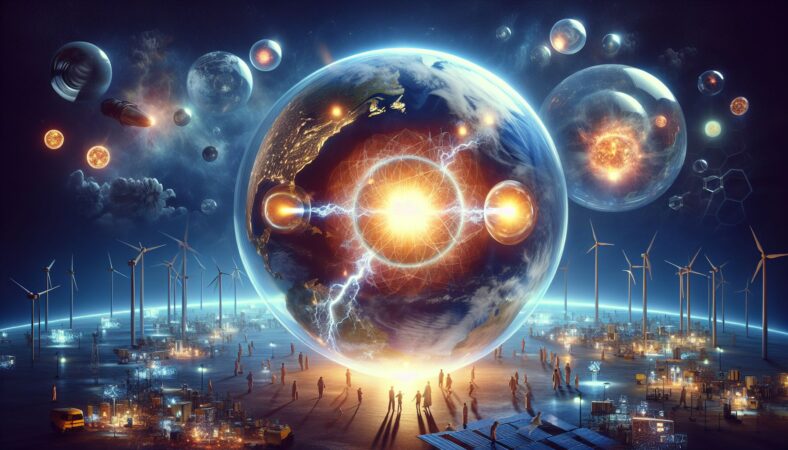
Greetings, fellow tech aficionados! Today, I’m excited to dig into a topic that’s as electrifying as it is fascinating—nuclear fusion. Now, before you roll your eyes and think, “Nuclear? Isn’t that the stuff of Godzilla movies?” hang tight. Nuclear fusion is less about monstrous reptiles and more about clean energy that could power every espresso machine in the world for millennia. You see, fusion is the Bono of the energy world—loved by many, controversial to some, but undeniably influential.
A Brief History: From Big Bang to Power Plant
Let’s jump into our DeLorean and take a short trip back in time. Nuclear fusion isn’t just a recent blip on the tech radar. Its origins date back billions of years, to a moment next to a cosmic flicker, aptly named the Big Bang. The very stars we wish upon every night are fusion reactors, churning out energy by merging hydrogen atoms to form helium.
Scientists have been eyeing fusion since the 1920s, dreaming of bottling the sun in a human-made reactor. This isn’t out of some Solar Superiority Complex, fusion promises to deliver almost limitless energy. In the lab, we’ve seen the sizzle, but we’re waiting for the steak.
How Fusion Works: Not Rocket Science… Well, Maybe a Little
Okay, let’s get a bit technical for a second without turning this into an episode of Bill Nye the Science Guy. Fusion involves heating up a mix of hydrogen isotopes, deuterium and tritium, to astoundingly high temperatures. At these sweltering levels, nuclei start to overcome their natural repulsion and smash together. It’s like a cosmic game of bumper cars.
When these nuclei fuse, they release energy, a heck of a lot of it. We’re talking about ten times more than conventional fission reactors and a barrel-load more than your standard coal plant. No greenhouse gases, no meltdowns, just good old energy with a fraction of the radioactive waste.
The Present: Where Are We Now?
So, where are we on this fusion rollercoaster? Imagine being on a road trip and every sign says, “10 miles to Nuclear Fusion!” Well, maybe that’s a stretch, but in December 2022, the U.S. Department of Energy announced a major milestone. They achieved net energy gain during fusion experiments, meaning, they produced more energy than they used to kick off the reaction. This feat took place at the National Ignition Facility in California, proving that fusion isn’t just some sci-fi fever dream.
However, converting these lab successes into power plant reality is no small fry. Enter companies like ITER and Helion Energy. These guys are like the Apple and Samsung of nuclear fusion, each trying to crack the code of a sustainable and economic fusion reactor.
The Challenges: Roadblocks and Speed Bumps
Now, before we all start singing “Age of Aquarius,” fusion’s path isn’t all rainbows and unicorns. First up, there’s the little issue of cost. Building a viable fusion reactor is like constructing the Taj Mahal, expensive and takes longer than expected.
Then there’s the whole confinement challenge. It’s tricky to maintain plasma as hot as the sun without melting everything around it. Imagine holding a lit sparkler inside a popsicle; the poor thing doesn’t stand a chance.
Tritium supply also poses a problem. As a rare isotope, its scarcity could rip a chunk out of the fusion future if we fail to come up with inventive solutions for its production.
Real-World Impact: A Game-Changer for Good
Alright, enough with the hurdles; let’s dream a little. Imagine a world without fossil fuels, where your electric car charges faster than you can watch a TikTok video. Fusion could be that future. It’s not just clean energy; it’s social equity, powering everything from tech hubs in Silicon Valley to rural villages in Africa without discrimination or scarcity.
With fusion, geopolitical energy tensions could become as outdated as rotary phones. Nuclear waste would be reduced almost to a non-issue compared to current fission reactors. And pollution? More like dilution. That was my dad joke quota, by the way; you’re welcome.
The Future: X-Men and Beyond
What’s next on the fusion timeline? Well, if the past few years have shown anything, it’s that we’re closer than ever before. Private companies, government labs, and even start-ups are throwing ‘fusion parties’ around the world, each competing for that Eureka moment.
If (and when) fusion becomes commercially viable, the Fourth Industrial Revolution will pale in comparison. Heck, even the Fifth. We can expect a seismic shift across every conceivable domain, from the tech industry to climate change policies, even impacting how we live on Mars (I see you, Elon Musk).
Conclusion: A Bright Horizon
To wrap up, nuclear fusion is an incredible blend of age-old wonder and cutting-edge tech. It’s the triumph of human ingenuity over cosmic-sized challenges. As a techno-optimist who spends more time reading about potential breakthroughs than is probably healthy, I believe we’ll see fusion power our world within my lifetime.
In the world of emerging technology, fusion is no mere buzzword, it’s a revolution in waiting. Until then, keep your eyes peeled for news from the world’s leading labs and companies. We’re on the cusp of something extraordinary, folks, and wouldn’t it be poetic justice if, after centuries of burning fossil fuels, our future was as bright as the stars themselves?
Catch ya later, dreamers and doers! Keep fusing those ideas.